
Billy Graham in India 1956
December 30, 2025
Categories: Billy Graham

Early in Billy Graham’s ministry, he recognized the need to share the Gospel beyond his own country. In 1954, he held his first international Crusade event at Harringay Arena in London, England. The following year, he returned to England and then expanded to hold Crusades across western Europe, including stops in Paris, France; Oslo, Norway; and Geneva, Switzerland.
So, it came as little surprise when Billy Graham began planning an evangelistic outreach in Asia in 1956. It was soon settled he would preach in India for more than five weeks from Jan. 19-Feb. 27, 1956, as part of his India and Far East tour. During his visit, Rev. Graham would preach to 800,000 people, with thousands accepting Jesus as their Lord and Savior. His message to the people of India was the same:
“I am not here to tell you about an American or a Britisher or a European. I am here to tell you about a Man who was born right here in your part of the world, in Asia. He was born in the place where Asia and Africa and Europe meet. He had skin that was darker than mine, and He came to show us that God loves all people. He loves the people of India, and He loves you.”
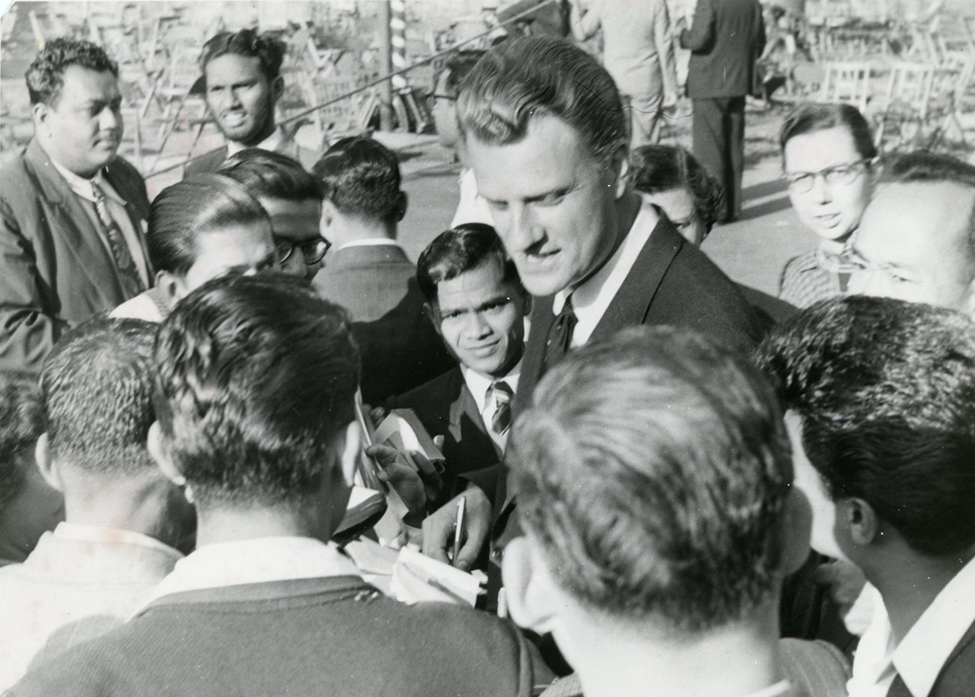
Billy Graham’s India tour included planned stops in Mumbai (formerly Bombay), Madras, Kottayam, Palamcottah, and New Delhi. The visit was not without its difficulties. In Mumbai, political riots had broken out that were unrelated to Rev. Graham’s visit. Mobs filled the streets, throwing rocks and looting. Over 50 people were killed during the riots, including two outside the stadium where Billy Graham was to preach. Unfortunately, the civil unrest necessitated the cancelation of the Crusade event there, so Billy Graham used the time to meet privately with local Christian workers and pastors.
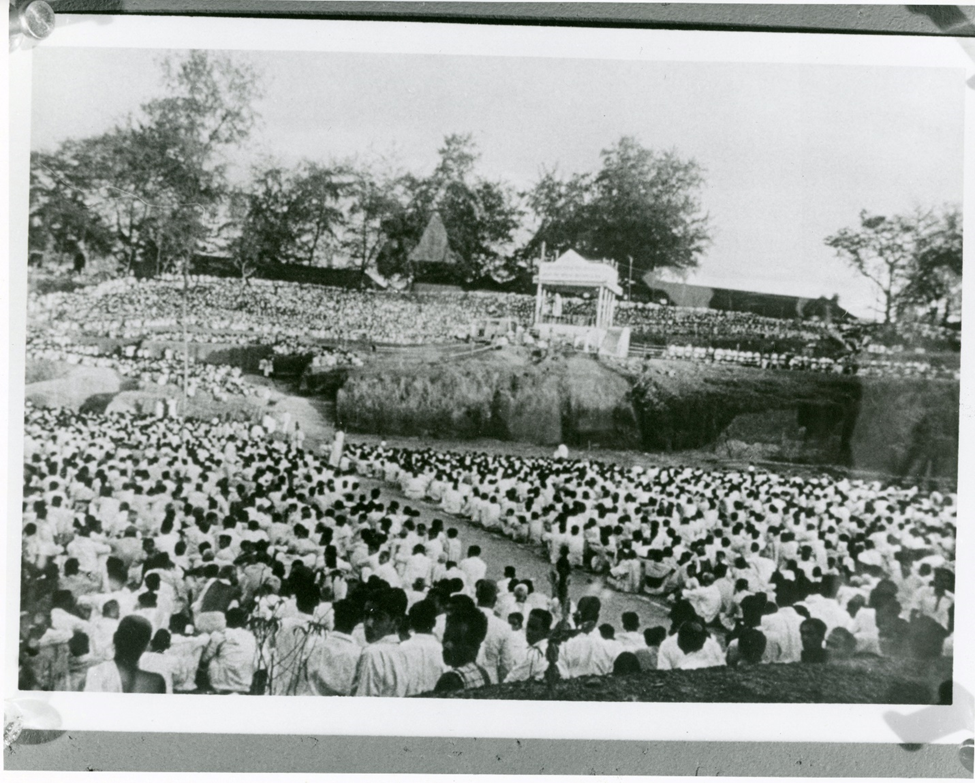
At the next stop in Madras, the team found the city packed with expectant crowds who had traveled to hear Billy Graham preach. Some people had ridden the train for days to get to the city. In his autobiography, Just As I Am, Rev. Graham recounts how he shared the Gospel with those who came to hear:
“In my messages, I did not directly attack the views of those who adhered to other religions; I was not in India to stir up controversy. Instead, I concentrated on presenting in a positive way the message of Christ as simply and forcefully as possible. Throughout my ministry to date, I had seen that the message of Christ, if accepted, had the power to replace false ideas and beliefs. However, it was necessary at times in India to explain that Christ wasn’t just another deity who could be added to the list of thirty thousand gods and goddesses already worshiped by Hindus in general. He was uniquely God in human flesh, and He alone was worthy of our worship and commitment.”
At his third stop in Kottayam, Billy Graham saw equally excited crowds. The population of Koattayam at the time was only 50,000, yet 25,000 people came the first night. At the next meeting, 75,000 people came, and three days later, the crowd for the final night was 100,000. Over the course of the several days they were there, Billy Graham shared the Gospel with more than 300,000 people.
In Palamcottah, those gathered were so enthusiastic they nearly turned over the car the evangelistic team was traveling in as they were heading to a meeting at the local cathedral. Later, Billy Graham had to crawl out a window after speaking because the crowd had gotten so large both inside and outside the cathedral.
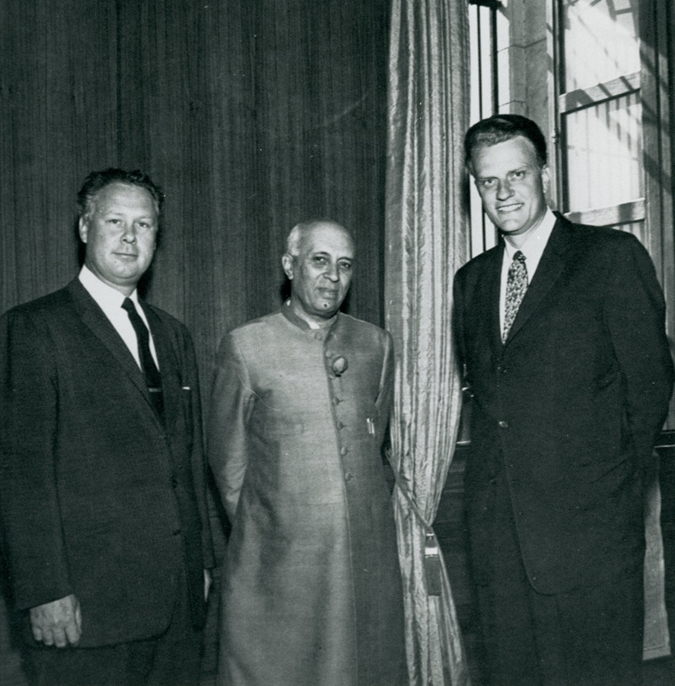
At the final stop in New Delhi, Billy Graham had the opportunity to meet with Prime Minister Nehru. He spent 35 minutes with the prime minister, initially feeling uncomfortable, as the conversation did not flow easily at first. However, after Billy Graham shared what Christ meant to him, Nehru perked up and began asking questions about Christianity and indicating he was not opposed to the work of missionaries in his country.
India left a lasting impression on Billy Graham. He later shared, “I was impressed by how friendly and loving the Indian people can be, and whenever I am asked what country I would like to go back to, I reply, ‘India.’”